Preventing the mental toll linked to racism in the workplace from an intersectional perspective: AFMD members explore the topic
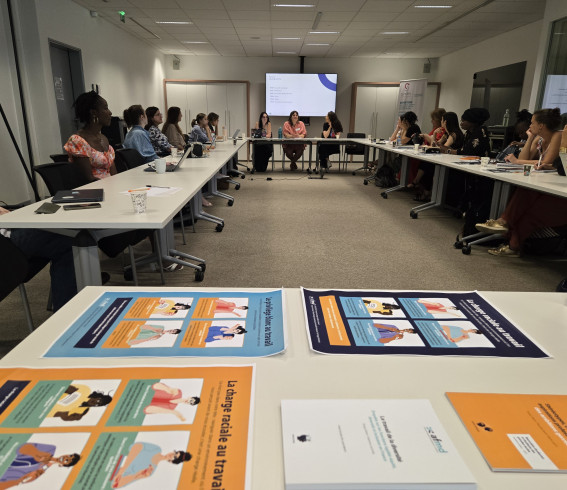
On December 9, 2025, the AFMD brought together 12 of its members to discuss the psychological toll linked to racism and its consequences in the workplace. This exploratory workshop enabled members to (re)discover how racial discrimination works and identify triggers for action.
What is the mental toll due to racism?
In her book Le triangle et l'hexagone, réflexion sur une identité noire, Maboula Soumahoro defines the mental toll linked to racism as “the exhausting task of having to explain, translate, and make violent, discriminatory or racist situations intelligible.” At work, people of color will suffer from microaggressions only ever perceived as innocent remarks when they, in fact, fall under everyday racism: " Your French sounds so fluent for a [...]!“, ”[...] is too aggressive, too cold, doesn't smile enough,“ ”Where are you from? Tell us about your country!"
This specific mental toll is not limited to insidious and indirect remarks; it creeps into many situations: being the only person of color on the team, being constantly corrected for the tone of your voice, having to reassure your colleague that they’re not racists, being put forward only for internal communications related to DEI but ignored for strategic projects, or being mistaken for another person of color in the company, etc.
At work, people of color face situations where they’re essentialized, tokenized, or forced into educational roles against their will. They constantly anticipate discriminatory behaviors, adapt to their surroundings to the point of erasing their identities, exhaust themselves due to increased mental load, and must develop unsustainable defence mechanisms, whether for themselves or the company. All aspects of their careers are impacted by racism: from their career advancement to their credibility in areas of influence, including their daily tasks and relationships with the teams.
Multiple dimensions
Furthermore, racial minorities will not all feel this mental toll the same way. Black women may suffer from racist stereotypes such as that of the “angry black woman”, while hijabi women will fall victim to the Islamophobic stereotypes of the “submissive” woman or the “accomplice terrorist.” Moreover, the model minority myth often attributed to people perceived as Asians generalizes them as submissive, hard-working, uncomplaining, etc. Far from being “positive” or “liberating,” this model is racist--it compares and minimizes the experiences and struggles of ethnic minorities, to the detriment of Black and North African people, notably in France. It would also be interesting to study how people of color themselves can absorb discriminatory mechanisms, suffer from internalized racism, and thus contribute to this mental toll by reproducing discrimination against their peers in order to get closer to whiteness and the privileges it gives access to.
What are the manifestations and mechanisms of the mental toll linked to racism at work?
During the workshop, the AFMD had the pleasure of welcoming Alexia Sena and Marie Dasylva to gain perspective on the subject.
This specific mental toll creates a state of energy-sapping hypervigilance that hinders life and reduces people of color to mere survival. Whether it's their clothing styles, hairstyles, or even the ways they express themselves, racial minorities are hyper-aware of the image they project at work and constantly conform to it.
At work, racial load has other consequences, such as the denial of their skills and self censorship. While professionalism can take many forms, its diversity is rarely accepted. Marie Dasylva invites all people to ask themselves who in society has the privilege of being judged solely on their skills…? Even the room for error is different, reinforcing the pressure on people of color to be flawless. Alexia Sena also points out the risks of diversity washing: people of color are often symbolically promoted within organizations as proofs of “diversity,” without any real guarantee however that practices to prevent discrimination truly exist.
In the professional world, taking action to prevent and address the impacts of racial load
At work, racial load has many consequences: for people of color, it can cause stress, anxiety, and depression; but it can also create and amplify tension and misunderstandings within teams, or limit the culture of inclusion, among other things, for companies. All the more reasons to address the issue, which is what the AFMD and its members worked on during the exploratory workshop in sub-working groups. Measuring discrimination, ensuring compliance with processes and systems, training and raising awareness, addressing microagressions... It seems that diversity managers and their senior management, managers, and employees have many ways of advancing the inclusion of racial minorities. Racial load is not an individual issue: speaking out against it is the first step towards collective resistance.
Want to discover the tools created during the workshop?
Ressources
- Alexia Sena, « Joyeux Bazar ». Podcast, Ausha. https://podcast.ausha.co/joyeux-bazar
- Douce Dibondo, « La charge raciale. Vertige d'un silence écrasant ». Livre, Payot et Rivages. https://www.payot-rivages.fr/payot/livre/la-charge-raciale-9782228939126
- Maboula Soumahoro, « Le Triangle et l'Hexagone, Réflexions sur une identité noire ». Livre, La Découverte. https://www.editionsladecouverte.fr/le_triangle_et_l_hexagone-9782348041952
- Marie Dasylva, « Survivre au taf ». Livre, Éditions Daronnes. https://editionsdaronnes.fr/product/survivre-au-taf/